

If you only read the headlines, you’d think the question was settled.
The Philippine outsourcing industry — the one that employs close to two million people and brings in around $42 billion a year — has spent the last year repeating a calm, confident line: AI is creating more jobs than it takes. The numbers they show back it up. Headcount went up, not down. Revenue per worker climbed. The industry groups have even named the new roles AI is supposedly minting: prompt engineers, AI trainers, quality controllers, data annotators.
It’s a reassuring story. It’s also not the whole one — and the part they leave out is the part that actually matters to you.
Two true headlines, one missing story
Here’s the same year from a different desk.
A Filipino freelance writer watches the writing category on Upwork shrink by nearly a third in a single year — the steepest fall of any category on the platform. A single entry-level posting now pulls more than fifty applicants. Plenty of clients post jobs and never hire anyone at all, because they’re testing whether the AI can just do it instead. Content writing for small businesses, once a dependable Filipino raket, has mostly evaporated.
Both of these are true at the same time. The industry’s “we’re adding jobs” and the freelancer’s “my work disappeared” are not in contradiction. They’re describing two ends of the same machine.
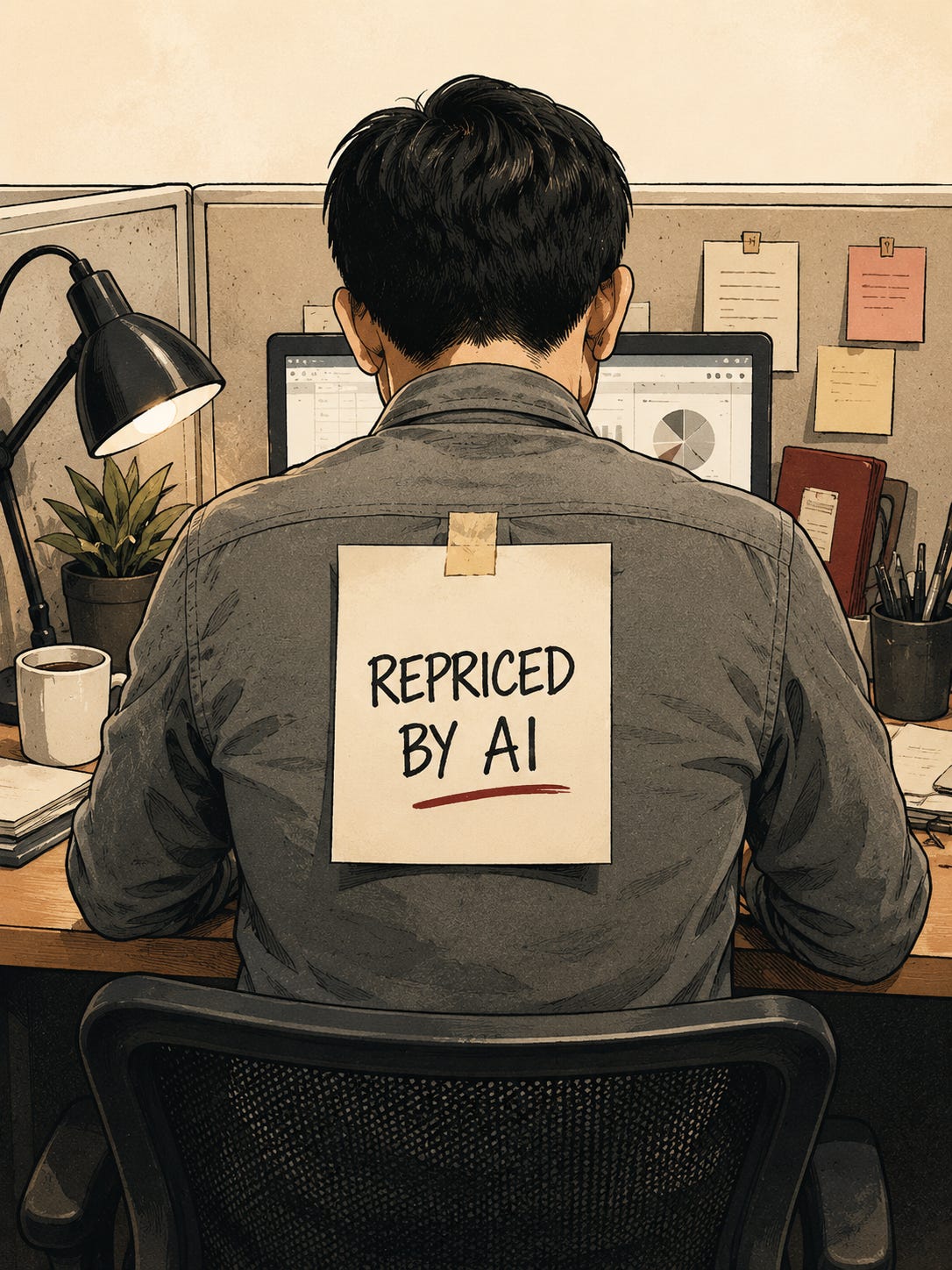
Because AI isn’t really deleting Filipino work. It’s re-pricing it. Some skills are suddenly worth far more. Others are suddenly worth almost nothing. And the comfortable middle — the generalist work that paid a steady wage for steady competence — is the part being squeezed out fastest.
The split, in plain numbers
Look at what’s rising and what’s falling, and the pattern is hard to miss.
Falling: data entry, basic graphic design, generic copywriting, routine call-handling. The common thread isn’t “creative” or “technical.” It’s replaceable — work where the task is predictable enough that a machine can do a passable version, so the price collapses toward zero.
Rising: AI integration, data annotation and labeling, specialized analytics, the kind of video and technical work where human judgment still beats the machine. On the freelance side, the platforms report AI-related skills climbing while the generic categories sink. Inside the BPO towers, the same story wears a corporate suit — the routine voice roles carry the highest displacement risk, while the “AI-assisted” specialist roles are where the new pay is. One industry estimate puts only a small slice of the BPO workforce at high displacement risk right now — but “right now” is doing a lot of work in that sentence, and the slice grows every year you stand still.
The reassuring version and the frightening version are both real. What neither tells you is the thing worth knowing: there’s a line being drawn through the Filipino working world, and it doesn’t run between “safe industries” and “doomed industries.” It runs between replaceable and hard-to-replace — and it cuts straight through the middle of almost every job and raket there is.
Which side of the line
This is where it stops being news and starts being personal.
The mistake is to ask “is my industry safe?” The BPO sector is booming and still shedding routine roles. Freelancing is brutal for beginners and lucrative for specialists. The industry isn’t the unit that lives or dies. The task is. Two people with the same job title can be on opposite sides of the line, depending on what exactly they do all day and whether a machine can already do a cheap version of it.
So the more honest question — the raketista question — is smaller and harder: which parts of what I do are replaceable, and which parts are mine? The work where you exercise judgment, handle the messy exception, build the relationship, make the call the machine can’t — that’s the part holding its price. The work you do on autopilot is the part being re-priced toward zero, whether you’ve noticed yet or not.
None of this means panic. The annotation jobs are real. The specialist rates are climbing. The video work is up. There is more high-value work, not less — it’s just landing in different hands than before, and the hands it’s landing in belong to people who saw the line coming and moved across it on purpose.
What this is, underneath
Strip away the BPO press releases and the freelancer horror stories and what’s left is plain. The rules of Filipino earning are being rewritten in real time, not by erasing jobs but by quietly changing what they’re worth. The people who’ll do well aren’t the ones in the “right” industry. They’re the ones who looked honestly at their own work, found the replaceable parts, and got busy becoming hard to replace — before the re-pricing reached them.
That’s the whole game now. Not “will AI take my job,” but “which half of my job is already on the wrong side of the line, and what am I going to do about it this year.”
We’ll be coming back to this one a lot.